Showing posts with label Meat. Show all posts

3.14.2012

A Farmer Ken Connection and Quatre Epices

Quatre Epices -  a spice mixture that in French means "four spices", which is deceiving because the recipe I have from Robert is actually made with 8. Anyhow, it can be used in almost every dish imaginable, savory and sweet, including duck confit.  The recipe for it is at the bottom of this very post - to be dashed in your mashed potatoes, pumpkin pie, roasted chicken, etc, etc, etc. If need or desire be, skip the duck adventure and scroll on down... No offense taken. 

It's true, every woman needs a source of duck, and I am no exception. I became entranced with the dish of duck during my second session at The Chef's Studio where a theme quickly became apparent - all things duck. I can still pull recipes from that session's notebook and smell the aroma of duck fat, those intoxicating molecules which cling to every object it glides by.


12.30.2011

The Pig, the Puff, and the Pie of Portland...


I'm scrawling down these thoughts as I sit (gratefully) inside our well-heated car, awaiting Eric's exit from within the tire store. Apparently one should possess snow tires to cross the rockies in the middle of January so as to safely move from Portland to Santa Fe.

So I decide to wait (gratefully) inside our well-heated car and scrawl thoughts while he did quintessential manly things - like buy snow tires.

It's pouring rain in Portland for about the 4th day in a row, and I listen as the guy on the radio confidently announces, amidst trying to sell outdoor gear, that we are in fact in the middle of a Pacific Northwest winter.
You think? Genius that one is.


I check Santa Fe weather on my phone. (I got tech-saavy for Christmas)
A big fat yellow dot plops itself on my screen. Part smiley. Part snarky...
The sun.
It still exists!
All the way across the Rockies.

Now I fully recognize that this here blog has had its own bit of a holiday vacation. It was all, "I need to sleep in, take a hot bath, and probably buy a Christmas tree or something." Low blow. Who can argue with Christmas? I surrendered - Vacation it had.

Christmas Tree 2011

I also fully recognize that this here blog has deviated a bit from its intended path - the making of a Mennonite cookbook. Partly out of its own (and mine) organic evolution, partly out of that fantastically fun French cooking course, and maybe partly out of that lil' decision to move cross country with the author's man.

But rest assured dear readers, 2012 will surely beckon us back on track! The desert pulls at the writer in me, and thus I declare...
There shall be a book! (or at least part of one) There shall be a hunt for a publisher, book proposals, decisions on recipes, interviews, probably a few chiles (cause you know... when in Rome), and a Mennonite Writer's Conference. Seems audacious doesn't it? I figure you, dear readers, will help keep me on track.

Meanwhile however, Portland is not leaving me wanting. And my attempts to revel in it are going quite well...

The sis Sarah came in for a visit!  Certainly there was a need for pizza (duh) and among other treats - the Chicken and Rice cart. It's so good you don't even mind eating off a newspaper stand, next to a parked car, in the freezing cold.


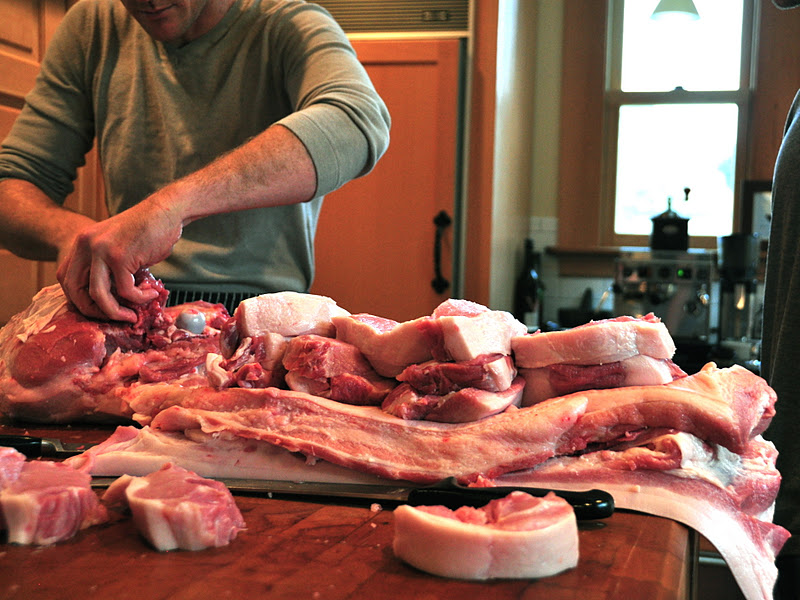
I then got in on the handiwork of an in-home pig butchery with some folks from the The Collective, Portland Meat Collective and The Farm. Thanks be to Bubba who raised the pig on many hazelnuts and much love!


Amidst the rush, I planned a much-needed moment of solitude at Breitenbush, one of my favorite spots in Oregon. I had to go back one last time - for the drive, the soak, the hike, the sauna. And of course that yummy, hippie, free-range, vegan lunch! 


A weekend with the girls to celebrate: a birthday, a pregnancy, a departure, surprise guests, and the Oregon coast...

photo by Emily Shirk Birky


A Goodbye Party with a Grapefruit Cake Disaster:


Salvaged Grapefruit Cake Bites:


Solstice Dinner with my first-ever attempt at Puff Pastry... 

photo by Janan Markee

They puffed!!!!


Janan, who has spent some time next to a Kenyan woman at a Kenyan stove, taught me the art of chapatis... It's all in the roll, the flip, and the fat. Yumm!!


And finally... my family, even from afar, celebrates Christmas with a Secret Santa Gift Exchange (though it's never all that secret-y by the end... surprises have never been our strong suit). 

Sister Jenny blessed me with a beautiful cookbook, which I immediately put to use on a Christmas Apple Tart. 
Thanks Alice and Jenny. I mean... Secret Santa... ahem. 


photo by Sarah Boyts Yoder

Happy New Years Dear Readers! 
Thanks for seeing 2011 close alongside me... 

Love love, 
Katie

9.25.2011

The Pig Roast and Pulled Pork

When I wrote my profile for this blog 6 months ago, it seemed intuitive to include my adoration of pork, and I have realized quite quickly in the last 6 months that I am not at all alone in this adoration. The size of the crowd that gathers for a pig party is one piece of evidence of this. The amount of writers dedicating their pen to the likes of the pig is another. A recent article in Slate provided a sharp reflection on this point - why these hoards of pig-adoring individuals exist. 

I admit... it's weird. Ridiculous even. 
But now is not the time for lengthy reflections on the subject of swine. Now is the time to talk about last night's ridiculously happy Pig Party. Its timing seems to symbolize the end of summer... the peaches are almost over. The apples have begun. Yesterday was sunny. Today was cloudy, cool, and my morning walk had a breeze that could only mean one thing - it is autumn. 


The celebrated pig sat in a brine of water, salt and herbs until Friday night when it was placed on a Traeger grill. Slow & Low is the theme of this technique.


An enthusiastic group of marimba players graced the party with their rhythmic presence... Neighbors of the hosts, Janan & Levi, are not only the makers of the instrument, but also the teachers. So an eclectic group of teachers and students joyously played throughout the evening. What is it about marimbas that just makes me cry a just little bit? Well they do.

9.23.2011

Pig Butchering and Peach Pie

Everything has an end
Except sausage. 
It has two ends. 
- Low German Saying

It's true, the tradition of community pig butchering seems to be long gone. I've read and heard much about the Mennonite customs around butchering, called Pig Butchering Bees, but they're all told as relics of the past.  A "remember when..." if you will.

Perhaps our urban living insulates us from such ritual. Perhaps the presence of technology, the convenience of modern food, or the efficiency of slaughterhouses make the tedious labor of butchering a moot point. 

But then again... perhaps the point is not to be totally mooted. Just yesterday I participated in an annual event, hosted by Janan Markee and Levi Cole, that is: First - Butchering Bee. Second - Pig Roast. The events are in part for Levi's birthday, but its focus seems to really be on keeping ritual in our foodways. 

The pig. Photo by Levi Cole
The wonderful hosts


This event is intense in its ebbs and flows...

9.06.2011

Elise's Food (and Farm) Story, Part 2: Lemon Basil Chicken

Thanks to Elise Hofer Derstine for sharing her story and talents in the last post! A second Bravo should be handed to her for the Lemon Basil Chicken recipe that follows… Simple in its design, elegant to the eye, singing of summer, and like all good chicken dinners -- has you writing poetry and researching chicken ladies. Obviously.

Elise's pastured hens at Blue Heron Farms  
Elise feeding said hens

As for me lately... This has definitely (and without my meaning to make it so) become a year of travel. After my friend's wedding in Illinois (the one with the whoopie pie table!), I had the pleasure of spending a week at Martha’s Vineyard, that idyllic little island that Massachusetts lays claim to. It was as delicious as I could imagine... Small farm stands lining the windy roads with their delicacies of the season: Raw milk, berries,, peaches, tomatoes, homemade yogurt and cheese, pies, sweet corn, and on and on. And that’s not even mentioning the fish.
Cheers to you dear Martha.

Raspberry picking at Mermaid Farm... Twas the prettiest necklace I've ever worn
These later donned a Peach Berry Cake for our dessert
Milk from Grey Barn Farm

At the fish market, I picked up edibleVineyards magazine and immediately became entranced by an article about Nancy Luce, an eccentric woman who lived and died on the Vineyard in the 1800s. Nancy became famous for two things…
1. Her love of her chickens.
2. Her poetry about her love of her chickens.

Nancy Luce and her beloveds

8.31.2011

Elise Hofer Derstine's Food (and Farm) Story, part 1

"I want spiritual peace in my contribution to the world. Can I do all that just by raising chickens? Who knows. I’m here to find out." - Elise Hofer Derstine


Well now that we’ve got our cookie fix worked out for the time being, it seems some poultry and pig are in order, and of course another Mennonite Women’s Food Story. Today we’re talking Elise Hofer Derstine from Goshen, Indiana. Elise is talking the poultry and pig!

Elise Hofer Derstine. Photo by Libby Franklin

I first met Elise at Goshen College, sitting on the front porch of her house, probably eating cheese. Such was the Monday evening ritual during that time. There are a few things I could quickly sense about Elise even then: She exudes the being of a writer and a woman of trajectory, is a witty conversationalist and a clearly darn good cook.

Over the last few years I’ve kept up with Elise’s trajectory via good ole’ Facebook and certainly took note when the photos shifted from Washington DC urban life to pigs, chickens, and muck boots. She had clearly left city life for the the farm. Blue Heron Farm to be exact. So when I began reflecting on Mennonite food, Mennonite cookbooks and Mennonite women (oh and pork) Elise immediately came to mind. 

A more urban Elise perspective. Photo by Tim Hofer

The farmer-esque lens: Muck boots and Pigs. Photo by Rod Hofer

On that note, The Food (and Farm) Story of Elise Hofer Derstine, written by the farmer herself…

7.21.2011

A Reason for Wheat and Pig

I depart at 3:20pm this afternoon for the Sunflower State. Tomorrow promises cooking with Grandma Boyts, lunch with cousins and aunts, and then a "German" buffet at The Breadbasket for supper. 

In the meantime, I think I strained my arm carrying a pig. 


I woke up Sunday morning with an ache in my right arm and could think of nothing I’d done.  Nothing other than carrying that pig from table to smoker with Levi.  I was helping him out on a pig roast event. He was helping me on my pig anatomy and butchering. Apparently I still need to learn pig-carrying posture. Sigh.

This anatomy lesson got me thinking on a recent conversation I had with my Grandma Joan Dreier about her memories of pig butchering on the farm. Her job was to clean the casings for the sausage. She called it "neat", her sarcasm not lost on me. Got me thinking about my mother and her prize hog. 

My mother, Teresa, and her prize hog.

It got me thinking of the chapter on pork in Norma Jost Voth’s amazing book, Mennonite Food and Folkways of Mennonites from South Russia, Volume I  in which she describes the Mennonites' love of all things pork.  The first page of her chapter includes a Low German saying:
"He thinks highly of short
prayers and long sausages.
He hellt fal fonn en 
kortet Jebad onn ne lange Worscht."

Pig photos by Janan Markee

 My point here is not to give you strange Low German sayings about sausage to use as party tricks. Though it’s certainly an added bonus.

My point here is to expand a bit on the post “We Are Where They Ate” which gave a wee bit of Mennonite history, explaining that there were basically two Mennonite veins of immigration to North America – the Swiss/German and the Russian. My essential questions today:
Why are there Mennonites in Kansas?
Why are there Russian Mennonites in Kansas?
If these Mennonites are “Russian” why are they talking about sausage in Low German?

My last evening in Portland for a bit - Navarre. Was a perfect departure meal.

Ok, the story on the Russian Mennonites:  In the late 1700’s there was a Mennonite group in Prussia (what is now Poland), many of whom had come to Prussia from the Netherlands. (The Dutch influence being an important point when you're studying food history.)

This Prussian group began a resettlement to southern Russia in the 1780s upon the invitation of Catherine II, the Russian ruler at the time.  Her real aim was to settle land Russia had taken from the Turks in war, a fact the Mennonites likely didn’t quite grasp.  The logic of the invitation being that if the land was settled, it would assure Russia’s continued possession of it.  Tricky, if you ask me. But with land issues at home in Prussia, the Mennonites were pretty well primed to depart.

The deal looked even prettier with the package of privileges the Mennonites were promised. It almost seemed tailor-made:
- The Mennonite communities (often called "colonies") they established could be independent, essentially allowing them to operate in total isolation.
- Complete religious freedom, meaning no more persecution from Catholic or Reformed governments
- Exemption from military service, an especially important point considering Mennonites were and are pacifists. This tended to be a point of contention in most places of residence. 
- Special permission to brew beer and distill brandy, something the Mennonites were famous for in Prussia. Who knew? 

So they moved. And so began a 200+ year history of Mennonites in Russia. Of course moving wasn’t as simple as that. It wasn't packing up a U-haul and driving a few hundred miles at 60mph, listening to the Indigo Girls and dreaming about your garden on the other side. It was the 18thcentury after all. And wintertime. It was also a much more gradual migration from Prussia than this implicates, lasting until about 1870.

Map of Mennonite colonies in South Russia The "Old Colony" was the first


In keeping with pig themes - Navarre's pork pate 

To make a long story pretty short, (the story being what it takes to be impoverished pioneers in a foreign country) the colonies and villages they built in southern Russia were soon thriving. They successfully established their own governing structure, schools, hospitals, orphanages, economy and so on. Way of life in Russian Mennonite colonies is a study in and of itself, to be sure. 

Here’s the crux though – These Russian Mennonites from Prussia spoke Low German, a regional variety of West Germanic languages, from the time they arrived in Russia to the time they left. No, I won't judge you for having to reread that. And because they were given the privilege of living in basic isolation from the rest of the Russian culture the vast majority didn’t ever learn the Russian language, and they saw no need to. The isolation was even more pronounced as proselytizing  was not allowed by the Russian government. This had several implications, one being that there were few intermarriages between Mennonites and Russians. Marriage meant acculturation, the blending of families. 

However something serious shifted in the 1860s when the Russian government began requiring that the Russian language be taught in the Mennonite schools. Cornelius Dyck, a Mennonite historian, claims, “It is possible that this development conditioned the Mennonites to see the German language as an essential part of the Mennonite faith itself.”

Voila… Language becomes part of one’s faith. The ability to view "Mennonite" as part of one’sethnic identity found its fertile ground.

Something even more serious shifted in 1874 when the privilege of military exemption was lifted and replaced with the promise of alternative military service, like working in the forestry service. This alternative just wasn’t enough for many folks though.  So you guessed it… From 1873-1874 about 18,000 immigrants came to the Midwest.  A large group (probably around 5,000) of which chose central Kansas as home. Why Kansas? There were already some Swiss/German Mennonites who had come from Pennsylvania in Kansas, the railroad business wanted them, and land was being sold at a good price - $2.50 cents an acre. The price of my Americano this morning.  

Reminds me of that that Paul Simon song… 
“I’ve got some real estate here in my bag
So we bought a pack of cigarettes and Mrs. Wagner’s pies
And we walked off to look for America”.

Except they were on ships with zwieback. Then wagons. Look for America, Kansas, Harvey County.   

Map of Mennonite congregations in Kansas


So colonies were established in the prairies of central Kansas. Interesting fact: The Russian Mennonites 
are responsible for having turned that vast prairie into the vast wheat fields as they are known today. Having tucked a few of those Turkey Red Wheat kernels on the boat and wagon, they planted away. Breadbasket indeed.   

Back to the crux – the language thing.  That the immigrants from Russia spoke German can make for a somewhat confusing history, albeit interesting. It certainly gave them trouble during wars against Germany when people were suspicious of German speakers. That they weren’t actually German was beside the point, or at the very least confusing.

Today in Kansas, many of the foods that the Russian Mennonites brought with them are now called “German” food, not Russian or Prussian or even Dutch.  German. So Friday night I will attend a German buffet that is complete with Russian Mennonite foods, which to be fair, aren't Russian foods either. This all makes sense I suppose… the folks who handed you that roll called it something in German. Called themselves something in German. Called everything something in German. Let us call it German.

Of note, I am not a descendant of Russian Mennonites. My mother’s side comes from Germany and France. The Mennonite part – Keturah's family – from Germany . My father’s side also comes from Germany. Yet the Russian Mennonite food is definitely part of my food story. Because to spend any time in this area of Kansas is to eat the food and know the descendants.  It meant my grandmother learned to make bierrocks and borscht and new years cookies. It meant we frequented the Breadbasket and dreamed of warm zwieback on the sleepy ride from Texas to Kansas, trying to spot the little white church on the horizon that meant the farm was only a few moments away. 


6.02.2011

Put a Bird On It.


I wouldn't be so bold as to say that roasted chicken is an heirloom Mennonite recipe. But that's just the point- "Mennonite food", in my opinion, is a rather fluid concept. Putting a bird in an oven is virtually universal. Plus I really love roasted chicken... sometimes that's just enough.

Also I have a firm belief that all people everywhere should know how to roast a chicken. Getting the one technique dialed gives you so much... perfect for a lazy Tuesday night, a fancy Friday dinner party or a Sunday family supper. It can be a one pot meal or the main course in an elaborate dining experience. The decision on vegetables, sauces, herbs are all yours. Room for creativity is boundless.

But every recipe you'll find for the dish is the one the chef swears by: Brine the bird. Brining not needed. Salt that little sucker before roasting. Only season after. Take out the wishbone. Or not. Put butter underneath the skin of the breast. Or not. Stuff the cavity with bread cubes, pancetta and chicken livers. Truss the chicken. Trussing... whatever. Rotate it while roasting. Rotating... maybe next time... It's an exhausting effort trying to sort through what really is going to deliver good results and what's a sham. So I'll just tell you... All of them. They are all going to deliver a delicious roasted chicken as long as it's not raw or overcooked and as long as you use salt somewhere. Ok there's also the recipe that said to put it in vinegar and a stick of oleo... I'd stay away from that one.

So here's what I did on my lazy Tuesday night. It was a rainy Tuesday in Portland so it all seemed appropriate. I had a chicken - a small, whole, 4.5 pound chicken. If you're lost, tell the butcher what you're doing with the bird. A good butcher will lead you to your mark.
I like to roast my chicken on a bed of veggies, especially on a lazy Tuesday night. So I looked around my kitchen and used what I had. Eric had to laugh at my choice of sweet potato as there's a running joke about my usage of the root. "You and a sweet potato are like Portland and birds," he says. Check out Portlandia for the reference and this will all make sense.

The idea of the dish was being led by Thomas Keller, accompanied by moi. The result was a beautiful marriage - the perfectly seasoned meat with a crisp exterior.
Just the smell of the veggies had me impatient for suppertime.
The mushrooms gently cut their way to us from the kitchen.
The garlic and thyme sang of the garden.
Accompany this recipe with your own ingenuity. I'm confident it will sing as well.


Whole Roasted Chicken and Veggies
Lightly adapted from Keller, Thomas. Ad Hoc at Home. New York: Artisan, 2009.

Yield: 2 generous servings with a bit of leftovers, or 4 small servings
Total time: about 20 minutes hands-on, about 80 minutes cooking and resting time

Ingredients:
One 4-1/2 pound chicken (but any size will do)
Salt and ground black pepper
1 large sweet potato, cut in large chunks
3 medium-sized red potatoes, halved
1 pound cremini mushrooms
1-1/2 onions, quartered
7-8 whole garlic cloves, peeled
6 thyme springs
1/4 cup olive oil

1. Remove the chicken from the frig and let rest at room temperature for up to 2 hours. Note: This isn't vital but does decrease cooking time.

2. Preheat oven to 475 degrees. Fahrenheit.

3. To prepare the bird: (See above options for ideas. The following was my own take) Generously season the cavity of the bird with salt and pepper. Add 3 of the garlic cloves and 3 sprigs of the thyme and massage the cavity, lightly smashing the garlic as you massage. Leave them inside for flavor. If you want to stuff the bird with something else, do so now. Any meat you stuff it with should be precooked though.

4. Truss the chicken. Note: The purpose of trussing is for aesthetics and to help keep the juices inside the bird. Having said that, you can skip this step and it won't hurt.

5. Combine all the vegetables in a large mixing bowl: sweet potatoes, red potatoes, the 5 remaining garlic cloves, mushrooms, onions, and the 3 remaining sprigs of thyme. Toss with 1/4 cup olive oil and seasoning of salt and pepper.

6. Return to the chicken and very generously season it with salt and pepper. This is also the time to put a pad of butter underneath the skin of the breast if you'd like.

7. Put all the vegetables in a roasting pan or cast iron skillet and nestle the bird in the middle. Cut the 2 Tablespoons of butter into small chunks and place on top of the chicken.

8. Put the chicken in the oven and roast at 475 for about 15 minutes. Turn down the temperature to 450 after 15 minutes. Roast for approximately 1 hour. The bird is done when the juices run clear as you separate the thigh from the breast. A meat thermometer should register 160 degrees. Remove from the oven and allow to rest covered with foil and a tea towel for 15 minutes. Note: If it's on the very edge of being done, go ahead and pull it as it will cook slightly more as it rests. Check again after rest period to ensure this though.

9. Reheat the vegetables over medium heat in the same pan.

10. For service, take off the trussing string, cut the bird into serving sizes, and arrange with veggies.


In other Shoofly Project news... I'll be e-cooking and talking with Kate Stoltzfus from Pittsburgh soon! I can't wait to see what she and her Mennonite roots have baking!